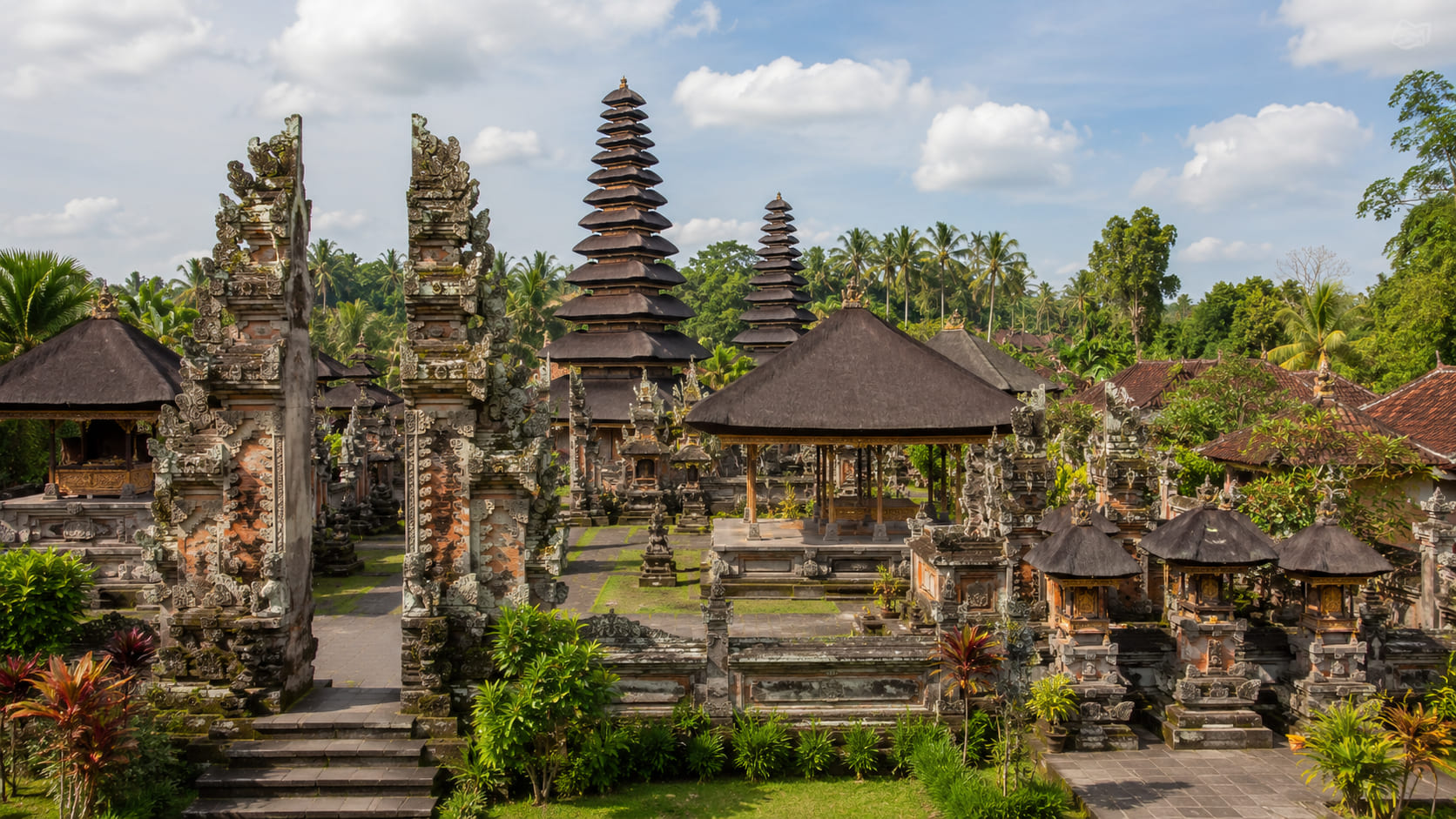
Travel around Bali for a few days and you may see temples in family compounds, village centers, rice-growing areas, lakes, mountains and along the coast. It is tempting to search for one simple classification system that explains every pura. In practice, Balinese temple life is more flexible and locally specific than a neat tourist chart suggests.
Still, several broad categories are useful. Understanding them helps visitors see why two temples can look architecturally similar but serve very different communities and ritual purposes.
Village temples form a basic local framework
Many Balinese villages maintain temples associated with different aspects of communal religious life. A commonly discussed group is the kahyangan tiga, or three village temples, often including Pura Puseh, Pura Desa or Bale Agung, and Pura Dalem.
The exact arrangement and naming can vary. Indonesia’s official tourism material on Penglipuran, for example, identifies Pura Penataran, Pura Dalem and Pura Puseh as important village temples there. That local example is useful because it shows why a general model should not be forced onto every community in exactly the same way.
Family and household temples bring worship into daily life
Sacred architecture in Bali is not limited to major public attractions. Many family compounds include household shrines, while larger kinship groups may maintain temples connected with ancestors and lineage.
For visitors, these are usually private or semi-private spaces. Do not walk into a family compound because a gateway looks beautiful. A visible shrine is not an invitation. Ask permission when visiting a home, and understand that photography rules may be different from those at a ticketed public temple.
Water temples connect ritual with the management of water
Some of Bali’s most important sacred sites are closely connected with springs, lakes, irrigation and agriculture. Tirta Empul is famous for its holy spring and purification pools. Taman Ayun has a major place in the UNESCO-recognized Subak cultural setting. Ulun Danu Beratan is associated with lake and water worship.
UNESCO’s UNESCO-listed Subak cultural property in Bali explains how water temples participate in a cooperative irrigation system known as Subak. This is a reminder that a “water temple” is not simply a temple with a photogenic pond.
For a concrete example, see the earlier guide to Taman Ayun.
Sea temples occupy powerful coastal settings
Temples such as Tanah Lot and Uluwatu are widely described as sea temples because of their location and religious relationship with the coast. Goa Lawah also sits within a coastal sacred context.
Travel writing sometimes presents Bali’s sea temples as one perfectly planned defensive or spiritual chain. The reality is more complex. Coastal temples are important, but visitors should be cautious with claims that reduce many local histories into one geometric system.
The Tanah Lot visitor guide shows how tide, tourism and sacred access can overlap at one of the best-known coastal sites.
Directional and island-level temples have wider significance
Some temples are understood as having importance beyond one village or family. Terms such as kahyangan jagat and sad kahyangan are used for major temples connected with broader sacred geography and island-wide religious significance.
Lists and classifications can vary depending on tradition and source, so visitors should avoid arguing over whether a temple “belongs” in one definitive list. Besakih and Lempuyang, for example, have significance that clearly extends beyond a single local neighborhood, but their religious importance should not be reduced to a ranking system.
Royal temples reflect historical political communities
Temples associated with former kingdoms and royal centers add another layer. Taman Ayun is closely tied to Mengwi. Such sites can express religious, political and social relationships that developed over centuries.
Calling a site a “royal temple” does not mean it stopped being sacred when a kingdom lost political power. Many historical temple complexes remain active and meaningful to communities today.
Pura Dalem deserves more explanation than “death temple”
Pura Dalem is often translated for tourists as a temple associated with death, cremation and Shiva. That shorthand can be useful, but it is incomplete. These temples participate in a broader village religious system and should not be treated as macabre attractions.
A later article in this series will look more closely at Pura Dalem and why the popular label “temple of the dead” can mislead visitors.
Architecture does not always reveal function
A split gate, meru tower or walled courtyard can appear in different kinds of temple complexes. You cannot reliably identify a temple’s role by one visual feature alone.
The earlier guide to Balinese temple architecture explains the building blocks, while temple type explains social and ritual function. The two systems overlap, but they are not the same thing.
Use categories as a map, not a set of boxes
The most useful way to think about Balinese temple types is to ask who maintains the temple, what community it serves, what setting it relates to and what rituals take place there. A single temple may have historical, local and wider religious roles at the same time.
For travelers, this approach is better than memorizing a fixed list. It encourages you to ask why a temple is where it is and how it functions today. That is exactly the kind of context that separates respectful cultural travel from simply collecting photographs of similar-looking gates.