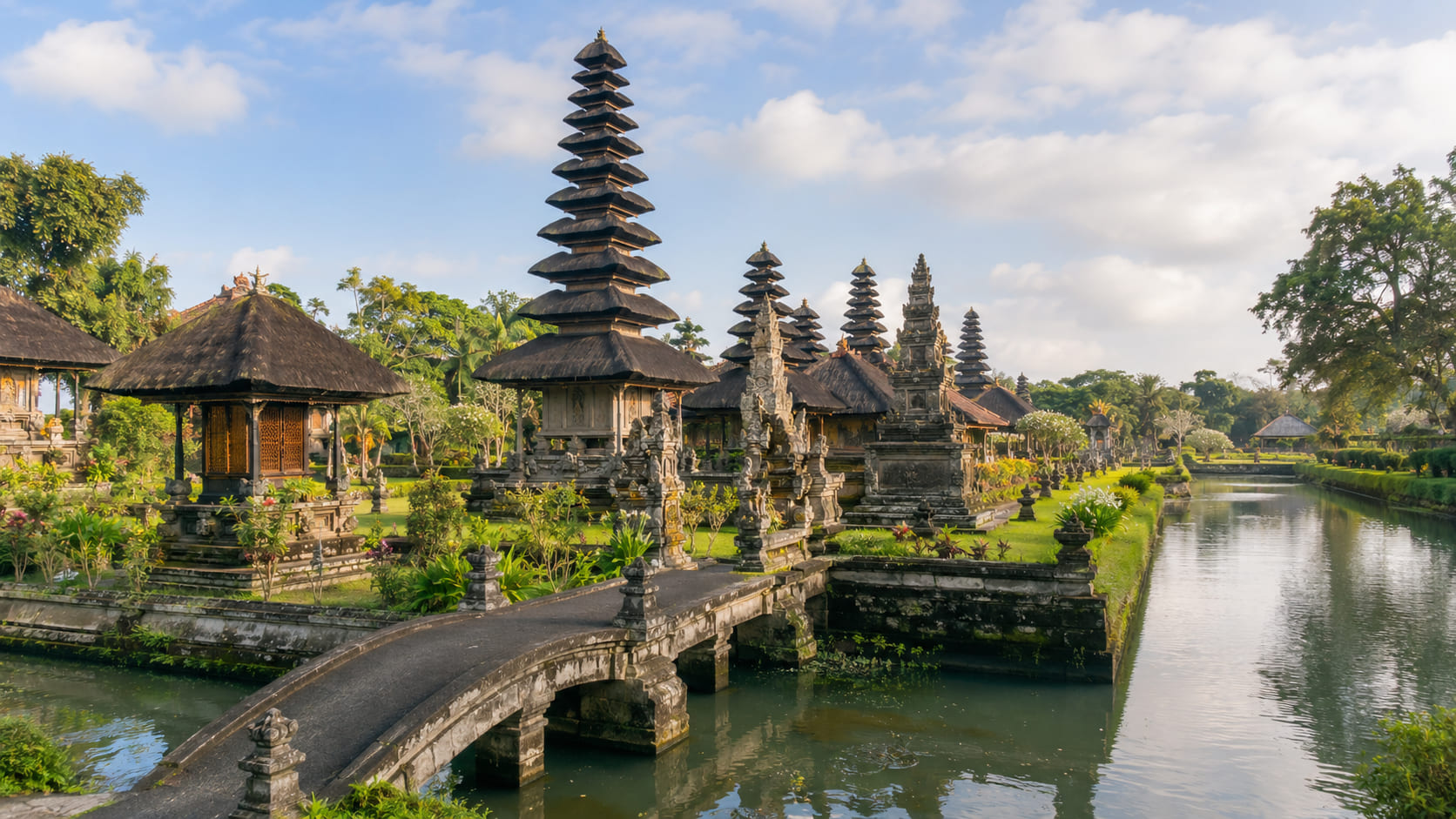
Pura Taman Ayun in Mengwi offers a different experience from Bali’s cliff, cave and mountain temples. The complex is defined by ordered courtyards, water, gardens and rows of tiered meru shrines. It is also part of the UNESCO-listed Subak cultural property in Bali recognized by UNESCO for the relationship between water temples, rice cultivation and the Subak system.
Because visitors often view the most sacred inner compound from outside its walls, Taman Ayun is also an excellent place to learn an important lesson about temple travel: you do not need unrestricted access to understand a sacred site.
A royal temple with more than one historical date
Taman Ayun is closely associated with the former kingdom of Mengwi. The Bali Government Tourism Office dates its foundation to 1634, while UNESCO describes the royal water temple within the UNESCO-listed cultural property as an eighteenth-century architectural element. These descriptions are not necessarily incompatible; major sacred complexes can have foundation dates, rebuilding phases and later architectural development.
For visitors, the important point is that Taman Ayun developed as a major royal and religious complex rather than a modern ornamental garden. The water, walls and shrines all belong to that historical context.
The moat changes how you experience the temple
Water surrounds key parts of the complex and creates physical separation between the visitor route and the inner temple. This is visually attractive, but it also reinforces distance and boundary.
Instead of treating the restriction as a disadvantage, use it as an opportunity to observe. From outside, you can see the rhythm of meru roofs, the arrangement of shrines and the way the enclosed sacred area sits within a wider garden setting.
If you have already read the guide to Balinese temple architecture, Taman Ayun is a useful place to test that knowledge. Look for changes between open public areas and more restricted sacred space, and notice how gateways control movement.
Why UNESCO includes Taman Ayun in a wider setting
Taman Ayun is part of the UNESCO-listed property called the UNESCO-listed Subak system in Bali. UNESCO describes the wider setting as a network of rice terraces and water temples connected to cooperative water management.
The official UNESCO listing is worth reading because it prevents a common misunderstanding. The heritage value is not limited to beautiful temple buildings. It lies in relationships among water, agriculture, religious institutions and community organization.
What to look for beyond the meru towers
The multi-tiered roofs draw the eye first, but Taman Ayun rewards attention to smaller details. Look at the long walls, bridges, gates and open spaces. Notice how the inner compound is visually available but physically controlled. That balance between seeing and entering is part of the visitor experience.
Do not assume that the tallest or most elaborate shrine is automatically the “main temple” in the simple sense used by tourist maps. Temple complexes can contain multiple shrines with different dedications and ritual roles.
September is a good month for an unhurried visit
Mid-September is generally near the end of Bali’s drier season. The grounds are often comfortable to explore, although strong sun can make midday visits hot. Morning or later afternoon usually provides softer light and a calmer pace.
Bring water and sun protection, but also carry a compact rain layer because seasonal boundaries are approximate. If rain arrives, stone surfaces can become slippery. The gardens may look especially vivid after a shower, so changing weather does not necessarily ruin the visit.
How to behave at a site that feels like a park
Taman Ayun’s spacious grounds can feel relaxed, and that atmosphere sometimes causes visitors to forget that they are at a religious site. Stay on designated routes and respect barriers around the inner compound.
Wear modest clothing and follow any sarong requirements in effect during your visit. Do not climb gates, walls or platforms for photographs. If ceremonies are taking place, keep distance and avoid using long lenses to photograph individuals in intimate moments of worship.
Use Taman Ayun to learn how boundaries can add meaning
Some travelers become frustrated when they cannot walk freely through the innermost courtyard of a temple. Taman Ayun shows why that expectation is misplaced. Sacred places are not designed around tourist access.
From the permitted route, you can still understand a great deal: the architectural hierarchy, the role of enclosure, the visual importance of meru towers and the relationship between water and sacred space. The restriction encourages observation rather than consumption.
A good visit to Taman Ayun is therefore less about “seeing everything” and more about learning to read what is visible. Connect the temple to the wider Subak setting, respect the limits of access, and the complex becomes one of Bali’s clearest lessons in how architecture, water and social history can meet in one sacred place.