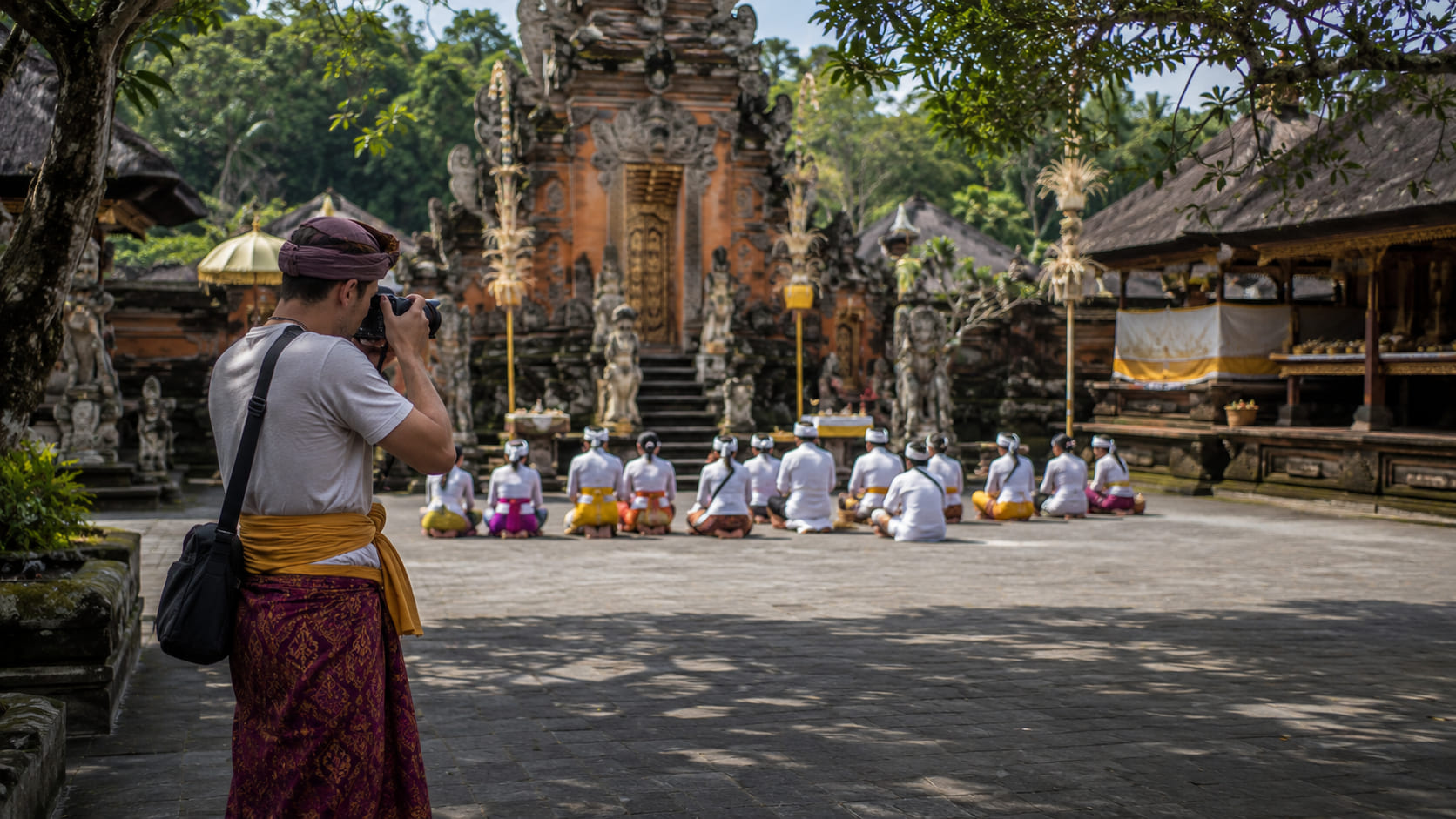
Bali’s temples are highly photogenic. Carved gates, meru roofs, stone guardians, ceremonies and dramatic settings naturally attract cameras. The problem begins when getting the image becomes more important than understanding where you are.
Temple photography is not difficult to handle responsibly. The core rules are simple: stay in permitted areas, give worshippers privacy, do not manipulate sacred objects and accept that some moments should not be photographed.
Start with permission, not camera settings
Before taking detailed photographs, look for signs and observe local rules. Some areas may prohibit photography entirely. Others may allow architecture but restrict images during prayer or ceremonies.
If a priest, temple attendant or guide asks you to stop, stop immediately. Do not argue that other visitors are taking pictures. Rules can apply differently to different areas and moments.
Bali’s 2025 foreign-tourist code explicitly prohibits behavior that desecrates sacred places, including taking indecent or inappropriate photographs. The Bali Government Tourism Office provides a summary of the 2025 conduct rules; check for any later updates before your trip.
Architecture is usually easier than photographing people
Gates, courtyards and exterior structures can often be photographed from public visitor areas without invading anyone’s privacy. People require more care.
Do not move close to someone who is praying for a dramatic portrait. A long lens can still be intrusive if you are documenting a private emotional moment without consent. Children deserve the same protection; do not assume traditional clothing makes a child public property for photographers.
Ceremonies are not open photo shoots
If worship is underway, read the earlier guide to temple ceremony etiquette before deciding where to stand. Stay behind worshippers and outside processional routes.
Avoid continuous shooting, bright flash and loud camera sounds during quiet prayer. Record a few images if permitted, then lower the camera and observe. The ability to photograph something does not create an obligation to document every second.
Never rearrange the sacred space
Do not move flowers, offerings, cloth, umbrellas or ritual objects to improve composition. The guide to canang sari and daily offerings explains why even a small object on the ground can have religious purpose.
Do not ask worshippers to repeat an action because you missed the shot. Do not borrow a ceremonial object as a prop. Do not climb a shrine platform for a higher viewpoint.
Gates need to remain passageways
Split gates create strong photographs, but they are also functional thresholds. At busy temples, visitors can easily block movement while posing.
The article on Bali temple gates explains why a threshold can mark changing access and sacredness. Take your photograph quickly when the area is clear and move aside immediately when worshippers approach.
Be careful with poses
Not every pose suitable for a beach, hotel or fashion shoot belongs in a temple. Avoid nudity, sexualized posing and physical contact with sacred structures. The 2025 foreign-tourist code specifically addresses inappropriate behavior and images at sacred sites.
Even fully clothed poses can be disrespectful if they imitate prayer for entertainment or use a shrine as a stage. Ask yourself whether the image treats the temple as a place of worship or as anonymous scenery.
Drones require more than airspace awareness
Aviation rules are only one part of drone responsibility. A flight may also be restricted by the temple, local community, event organizers or privacy concerns.
Never fly over a ceremony, crowd or inner sacred area without explicit permission. Drone noise can be disruptive even when the aircraft is physically distant. If you cannot confirm permission, leave it grounded.
Flash can damage atmosphere even when it does not damage stone
Visitors sometimes focus only on whether flash physically harms an object. In a living temple, the more immediate issue is disruption. A burst of light during prayer can be intrusive regardless of conservation concerns.
Use available light where possible. Inside dark spaces, accept that you may not get the photograph you want. A sacred site is not obligated to provide studio conditions.
Think before posting
Ethical photography continues after you leave. A respectful image can become misleading when paired with a false spiritual claim, an insulting caption or geotagging that encourages people to enter a restricted location.
Do not present a ceremony as entertainment if it was worship. Do not claim that you were “blessed by a priest” if you do not understand what occurred. Avoid turning local people into anonymous decorative characters in your travel story.
The best temple photographs come from attention
Slowing down usually improves both behavior and photography. You notice changing light, the relationship between buildings and setting, and moments that do not require intruding on anyone.
Take the image, then step away from the frame. A temple visit should leave you with more than a camera roll. When your photography respects boundaries, the photographs become a record of careful observation rather than evidence that the sacred place had to bend around you.