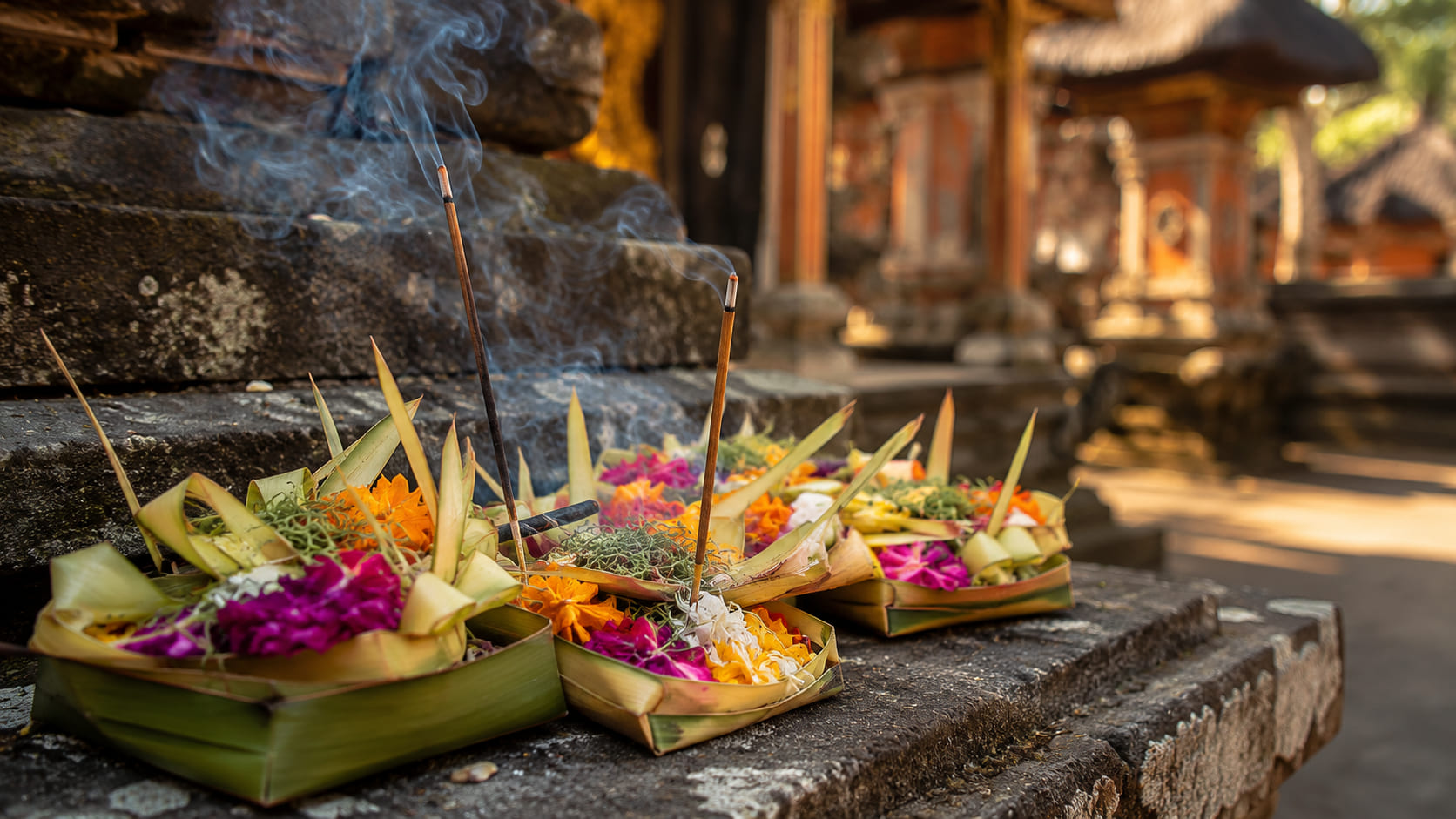
Small palm-leaf trays filled with flowers, leaves and other items are among the most visible expressions of daily religious practice in Bali. Visitors see them at temple entrances, family compounds, shops, offices, statues and sometimes directly on pavements. These offerings are commonly known as canang sari.
Because they appear so frequently, tourists can start treating them as part of the scenery. That is a mistake. A canang sari may be small and temporary, but it is still an offering created and placed with religious intention.
A canang sari is made, offered and then allowed to pass
The physical materials are usually natural and perishable. Palm leaf forms the base, while flowers and other components are arranged according to local practice. Incense is often added when the offering is presented.
Exact contents and meanings can vary, so be cautious with internet diagrams that claim every flower always has one fixed universal interpretation. Learning from Balinese practitioners is more reliable than memorizing a color chart from social media.
Indonesia Travel describes canang sari as a daily expression of gratitude and highlights the skill involved in making them. Its article on the Samsara Living Museum gives visitors an example of learning the practice directly in a cultural setting.
Why offerings appear on the ground
Visitors are often surprised to see sacred offerings placed on pavements, entrances and other low surfaces. The location is part of the ritual context, not evidence that the offering has been discarded.
Pay attention around doorways and temple steps. If an offering is fresh, incense may still be burning. Give it space and walk around it when practical.
The earlier guide to temple ceremony etiquette explains the same principle at a larger scale: ritual objects and worshippers should determine how you move, not the shortest route to your destination.
What happens if you accidentally step on one?
Accidents happen, especially on crowded streets where offerings are difficult to see. If you step on one unintentionally, do not panic or turn the moment into a dramatic public performance. Move carefully, avoid further disturbance and pay more attention.
Deliberately kicking, moving or mocking an offering is different. Bali’s official visitor guidance asks tourists to respect sacred sites, religious symbols and local customs. Basic awareness is part of that responsibility.
Do not move offerings for photographs
A canang sari can be visually beautiful, which makes it attractive to photographers. Photographing an offering from an appropriate distance is generally less intrusive than touching it.
Do not pick one up, rotate it toward the light or place it somewhere more photogenic. You do not know the ritual reason for its location. An image is not worth altering another person’s offering.
Learning to make one can be respectful when context is included
Workshops and museums sometimes teach visitors how canang sari are made. This can be a useful cultural learning experience when a knowledgeable Balinese teacher explains the materials, process and meaning.
The goal should be understanding, not turning a sacred practice into a craft trend stripped of context. Ask questions, follow the teacher’s instructions and avoid claiming expertise after one short workshop.
Offerings are part of a wider ritual system
Canang sari are highly visible, but they are only one form among many Balinese offerings. Major temple ceremonies can involve far larger and more elaborate preparations created by families and communities over significant time.
This is why visitors should avoid using “canang sari” as a label for every basket, tower or arrangement they see. Different offerings can have different names and functions. When you do not know, simply call it an offering rather than guessing.
Temporary does not mean unimportant
One of the most interesting aspects of daily offerings is their impermanence. Flowers wilt, incense burns out and natural materials eventually decay or are cleared away. The religious value lies in the act of offering, not in preserving the object forever.
For visitors from cultures that associate sacred objects with permanent preservation, this can require a change in perspective. An offering that looks old or damaged is not necessarily being disrespected. It may simply have completed its immediate ritual role.
Watch before you interpret
The best way to understand canang sari is to observe how they fit into daily life. Notice where they are placed, when incense is lit and how people move around them. Avoid interrupting someone who is in the middle of making or presenting an offering.
At temples, the same attention helps you understand the space more broadly. Offerings often make sacred use visible in places that might otherwise look empty to a tourist.
A small object can teach a large lesson
Canang sari remind visitors that Balinese religious practice is not confined to monumental temples or festival days. It is woven into ordinary routines and everyday places.
You do not need to understand every component to behave correctly. Look where you step, do not touch or move offerings without permission, and learn from people who practice the tradition. That basic respect is more useful than memorizing a simplified list of symbolic meanings.