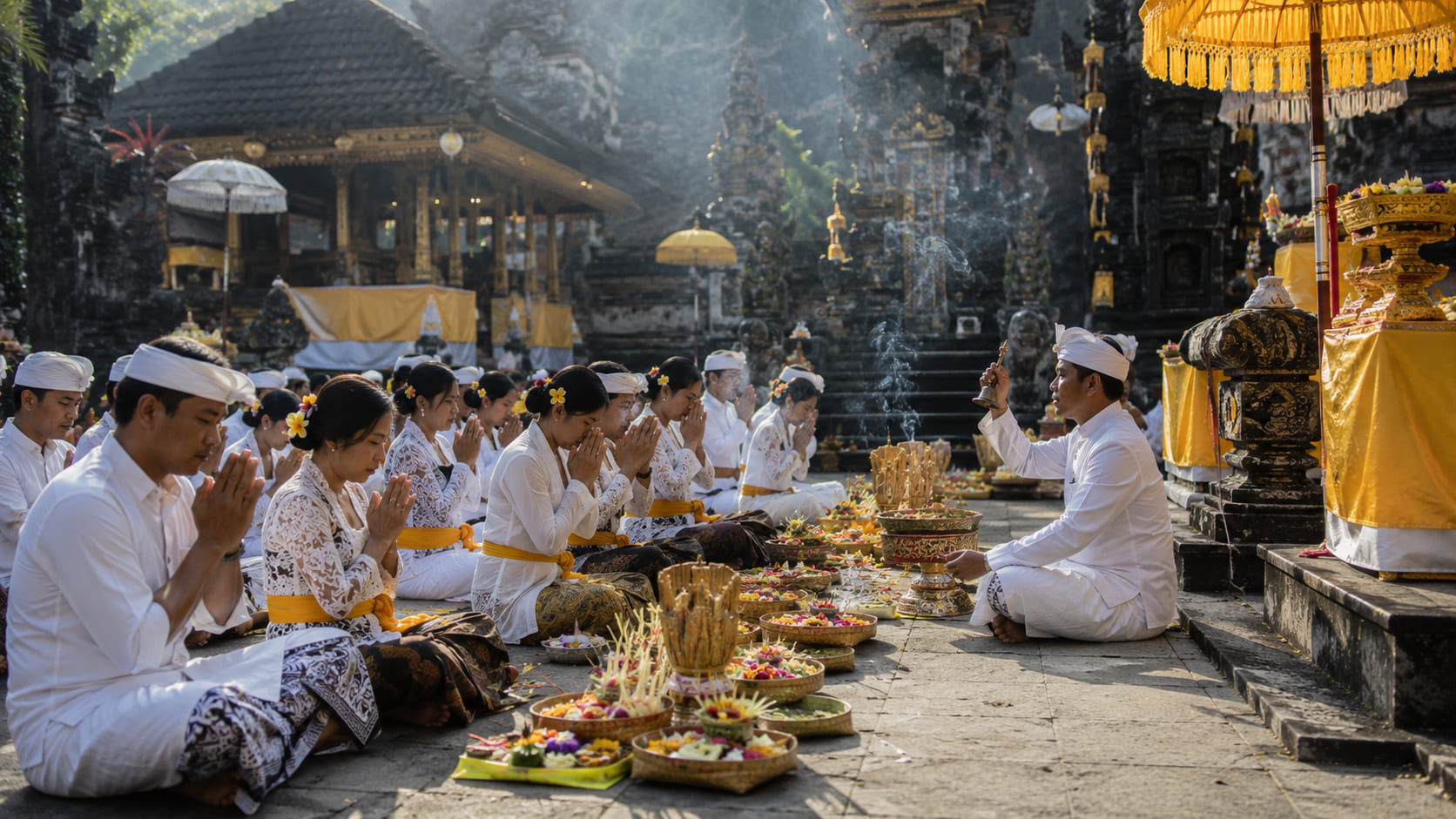
One of the most memorable experiences in Bali can be arriving at a temple and finding a ceremony underway. It can also be one of the easiest situations to handle badly. A visitor sees colorful clothing, offerings, music and processions; local families may be taking part in an important act of worship that has nothing to do with tourism.
The correct approach is not to disappear automatically, but neither is it to assume you have been invited into the center of the event. Slow down, look for guidance and remember that access can change during ceremonies.
First, find out whether visitors are welcome
Some ceremonies can be observed from designated public areas. Others may close parts of a temple entirely. Ask a temple attendant, local guide or clearly identifiable staff member before moving closer.
Bali’s 2025 foreign-tourist code prohibits foreign visitors from entering the innermost and middle sanctums of sacred places except for worship under the conditions stated in the regulation. Individual temples can also apply site-specific rules. Review the Bali Government Tourism Office’s 2025 visitor regulations and check for any newer guidance before your visit.
Do not use another tourist as your authority. Someone else crossing a boundary does not make the action permitted.
Dress for the ceremony, not for the weather alone
Temple clothing rules become even more important when worship is active. Wear modest clothing and the required sarong and sash. If you arrived unexpectedly in unsuitable clothing, use the temple’s approved rental or loan system when available rather than improvising with beachwear.
Traditional clothing is not a costume. Wear it correctly and avoid exaggerated poses that turn ceremonial dress into entertainment.
Stand behind the people who came to worship
Visitors should not occupy the best position simply because they arrived early with a camera. Give priority to worshippers and to the routes used by processions.
Gateways are particularly sensitive bottlenecks. The article on Bali temple gates explains why these thresholds organize movement between sacred zones. During a ceremony, stay clear of them unless you are specifically directed to pass through.
If people sit for prayer, remain behind or to the side rather than standing in front of them. Do not step over seated worshippers or offerings to find a better angle.
Photography should become less important, not more
A ceremony is not a performance staged for your camera. Wide photographs from an appropriate distance are usually less intrusive than close portraits. Never push a lens into someone’s face while they are praying, crying or carrying an offering.
Ask before using flash, and generally avoid it around prayer and ritual activity. Do not use a drone over a ceremony unless you have clear permission from all relevant authorities, including the site itself.
Most importantly, know when to stop. A few respectful images can document your visit. Recording every minute can turn observation into intrusion.
Offerings need physical space
Offerings may be placed on the ground, steps, shrines and temporary structures. Watch where you walk. Do not move an offering because it interrupts your photograph or blocks the easiest path.
The upcoming guide to canang sari will explain daily offerings in more detail, but the basic rule during any ceremony is simple: do not touch, rearrange or step over ritual objects unless instructed by someone responsible for the ceremony.
Music and dance may be ritual, performance or both
Visitors sometimes assume that any gamelan music or dance in a temple is a tourist show. That can be wrong. Some performances have direct ceremonial functions, while others may be presented for public audiences in a temple setting.
If you are unsure, behave as if the activity is religious rather than entertainment. Keep your voice down, avoid walking across the performance space and wait for natural breaks before moving.
Do not copy ritual actions without understanding them
Watching people pray can create a desire to participate. In some contexts, non-Hindu visitors may be welcomed to join certain activities with guidance. In others, participation is inappropriate or restricted.
Never imitate gestures, take holy water, light incense or join a procession simply because you saw another person do it. Ask first. Respectful observation is a complete experience; you do not need to perform someone else’s religion to prove cultural interest.
Ceremonies can change practical travel plans
Road closures, parking changes and large crowds are normal around major ceremonies. A temple may be partially closed or busier than expected. Build flexibility into your day rather than treating religious activity as an inconvenience.
If a ceremony makes your planned photo impossible, accept it. The temple’s religious purpose takes priority over your itinerary.
The best visitor role is often quiet witness
You can learn a great deal by watching from the correct distance. Notice how families arrive, how offerings move through the compound, how different courtyards are used and how architecture supports the flow of people.
The goal is not to get as close as possible. It is to understand what you are seeing without interfering with it. When in doubt, step back, lower your voice and ask. That combination of patience and humility is the most reliable form of ceremony etiquette in any Bali temple.