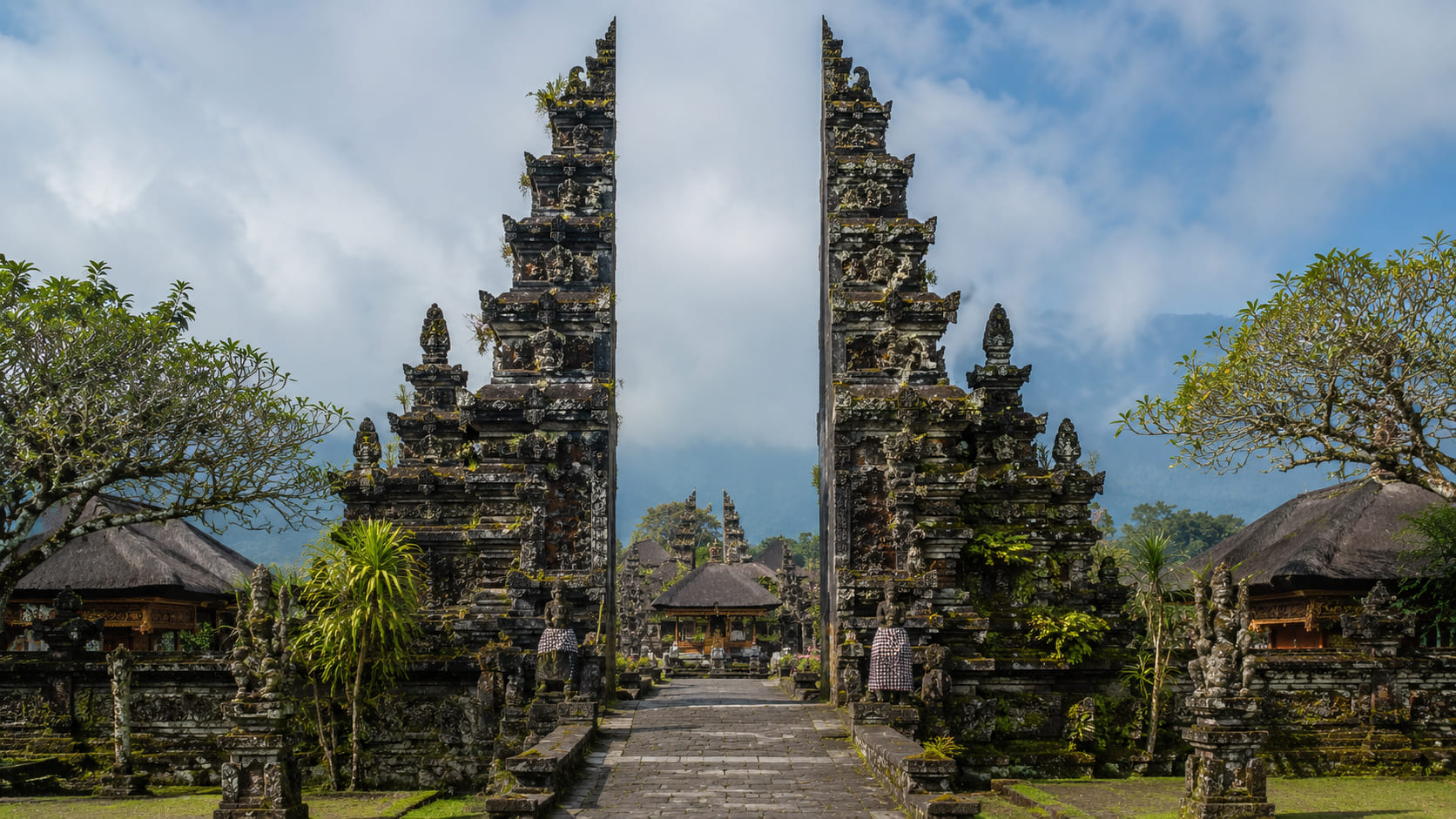
Few architectural forms are more strongly associated with Bali than the split gate. It appears at temples, palaces, public buildings and even modern hotels. For temple visitors, however, a gate is not simply a decorative entrance. It often marks a change in space, access and expected behavior.
Learning the difference between a candi bentar and a roofed inner gateway helps you read a temple more carefully. It also prevents a common mistake: assuming that a beautiful opening is an invitation to walk through it.
Candi bentar: the open split gateway
A candi bentar consists of two matching vertical halves with an open passage between them and no roof connecting the sides. In temple architecture, this form often appears at an outer boundary or transition into a compound.
Its visual power comes from symmetry and the strong sense of passing between two monumental forms. Many modern explanations assign the gate a specific universal symbolism, often involving duality or a split mountain. Such interpretations may be meaningful in some contexts, but the exact symbolism should not be presented as settled for every gate in Bali.
The safest factual statement is architectural: the candi bentar marks a threshold and is one of the characteristic gateway forms used in Balinese and older Javanese architectural traditions.
Kori agung and paduraksa: the more enclosed threshold
Deeper within a temple complex, you may see a tall roofed gateway with a defined doorway. Terms such as kori agung and paduraksa are commonly used for this form. It often marks entry toward a more sacred inner zone.
The doorway can be narrow, and the gate may be highly decorated. Guardian figures often stand nearby. The important visitor lesson is that the architectural form signals greater control over passage.
At Tirta Empul, the official Indonesia Travel description walks readers through successive courtyards and gateways, showing how movement through the temple is structured. That practical example supports the broader introduction in the earlier article on Balinese temple architecture.
A gate can be open and still lead somewhere restricted
Visitors often read open architecture as public architecture. At a working temple, that assumption can be wrong. A gate may stand open for worshippers, ceremony preparations or community members while tourist access remains limited.
Bali’s 2025 foreign-tourist code prohibits foreign visitors from entering the innermost and middle sanctums of sacred places except for worship under the conditions stated in the regulation. Site rules and instructions from temple authorities should always be followed. You can review the Bali Government Tourism Office’s summary of the 2025 visitor regulations and check for newer rules before visiting.
Do not decide that a space is public based only on whether there is a rope barrier. Sacred boundaries can be communicated through architecture, signs, custom and local instruction.
Guardian figures are not props
Many gateways are flanked by carved guardians, sometimes wrapped in cloth or incorporated into active ritual practice. Visitors frequently pose against them, touch them or place objects on them without understanding their status.
Keep physical distance from religious statues and sacred objects. A good photograph does not require leaning on a guardian figure. If cloth, offerings or incense are present, that is an additional sign that the object is part of living practice rather than static decoration.
Gates organize ceremonies as well as architecture
During a ceremony, a gateway can become a narrow point through which worshippers, musicians and offerings move. A visitor standing in the center for photographs can obstruct far more than pedestrian traffic.
Watch how people are using the space. If processions are forming, move aside before being asked. Never request that worshippers stop so you can finish a portrait beneath the gate.
This is where understanding different temple types also helps. A village temple on a ceremony day may use its gateways very differently from a major tourist site during ordinary visiting hours.
Why the “Gates of Heaven” image can mislead
The famous split gate at Lempuyang has made candi bentar a global social-media symbol. The image is visually effective, but it encourages people to see temple gates as freestanding photo installations.
In reality, the gateway belongs to a sacred compound and a larger mountain temple context. The earlier Lempuyang guide explains why visitors should look beyond the queue for the famous photograph.
How to read a gate when you arrive at a temple
Pause before walking through. Look for signs and observe who is entering. Is the gateway leading into a public visitor courtyard, or are only worshippers passing beyond it? Are offerings placed near the threshold? Is a ceremony underway?
Then look at the form itself. Is it a split gate with an open top, or a roofed doorway? Does the space become more enclosed beyond it? Are there guardian figures or a change in the density of shrines?
These simple observations turn a gate from a backdrop into evidence about how the temple works.
A threshold deserves a moment of attention
Balinese temple gates are memorable because they are visually strong, but their real value lies in what they do. They separate, connect and organize different spaces. They guide movement and often mark changing degrees of sacredness.
When you stop treating every gate as a photo frame, temple architecture becomes easier to understand. You notice where you are allowed to go, how people move during worship and why a boundary can remain meaningful even without a locked door.