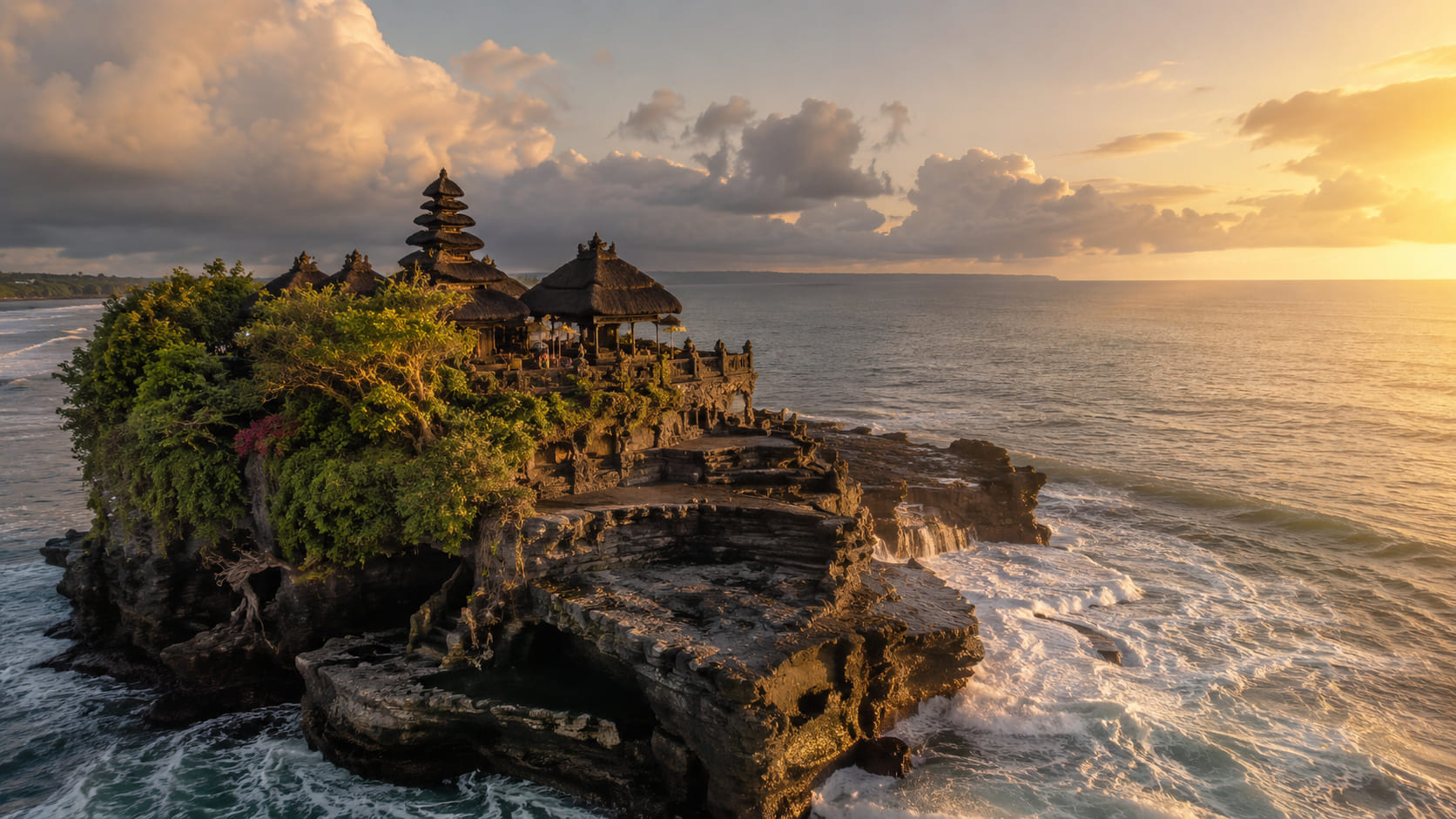
Bali’s coastline contains some of the island’s best-known temples. Tanah Lot stands on a rock shaped by the tide, Uluwatu occupies a dramatic cliff above the Indian Ocean, and Goa Lawah sits close to the sea around a sacred bat cave. Travel guides often group sites like these under the label “sea temples.”
The category is useful, but it can also create oversimplified stories. Coastal temples have different local histories, deities, communities and ritual functions. They should not be treated as identical stations in one tourist route simply because they face the ocean.
What makes a temple a “sea temple”?
In practical travel language, a sea temple is usually a pura with a strong physical and religious relationship to the coast. The ocean may shape the site’s setting, access, ceremonies or sacred orientation. At Tanah Lot, the tide determines how the offshore rock is seen. At Uluwatu, the cliff edge dominates the experience. At Goa Lawah, coastal geography sits alongside the cave sanctuary.
That does not mean “sea temple” is one rigid architectural type. A coastal temple may use the same kinds of gates, courtyards, shrines and pavilions found elsewhere in Bali. Its distinction comes from context and religious role, not from one required building form.
Tanah Lot shows how tide and worship can overlap
Tanah Lot is one of the clearest examples of a temple whose visitor experience changes with the ocean. At high tide, water can surround the temple rock. At lower tide, more of the rock shelf becomes exposed, although physical access never overrides religious restrictions or safety rules.
The earlier Tanah Lot temple guide explains why visitors should separate the idea of reaching the rock from the idea of entering sacred space. A low tide does not turn a temple into an open attraction.
Indonesia’s official tourism site also connects Tanah Lot’s traditional history with the priest Dang Hyang Nirartha. Such traditions are important, but they should be presented as religious and historical narratives rather than simplified into claims that every detail can be archaeologically proven.
Uluwatu demonstrates the power of a cliff location
Pura Luhur Uluwatu sits high above the sea on the Bukit Peninsula. The Bali Government Tourism Office describes it as a sea temple on a cliff roughly 70 m above the waves. The setting makes sunset a major visitor draw, but the temple remains a place of worship with restricted inner areas.
Here, the coast shapes movement differently from Tanah Lot. Visitors walk along cliffside paths rather than across tidal rock. Wind, exposed edges and monkeys create practical concerns that sit beside religious etiquette.
The comparison is useful: two sea temples can share a relationship with the ocean while offering completely different architectural and visitor experiences.
Goa Lawah links a cave sanctuary with the coastal setting
Goa Lawah is known for its bat-filled cave, yet its location near Bali’s southeast coast is also important. The temple is often visited on routes toward eastern Bali, and the road can make it feel like a quick stop between destinations.
As the Goa Lawah guide explains, the better approach is to see the cave, temple and coastal setting together. The bats attract attention, but they do not replace the sacred meaning of the site.
Be cautious with the “protective chain” story
A popular claim says Bali’s sea temples form a perfectly arranged chain in which each temple is visible from the next and together they create a spiritual barrier around the island. Versions of this story appear frequently in travel content.
Visitors should treat such neat diagrams cautiously. Bali certainly has important coastal temples and rich concepts of sacred geography, but local histories are more complex than one geometric system. Visibility between sites is also affected by distance, terrain and modern development.
A responsible cultural guide can acknowledge the broader tradition of coastal sacred places without presenting an attractive internet graphic as established historical fact.
The ocean is sacred context, not a scenic backdrop
Tourism marketing often uses the sea mainly as visual drama. At temples, that approach can miss how natural features participate in religious life. Water, mountains, springs, lakes and the ocean all appear in Balinese sacred geography and ritual relationships.
This broader idea is easier to understand after reading about different types of Balinese temples. A temple’s location can reveal something about whom it serves and how it relates to the setting, even when its architecture looks familiar.
How to visit coastal temples responsibly
Coastal locations create specific safety issues. Stay behind cliff barriers, respect tide warnings and avoid slippery rock. Do not enter the water near sacred areas simply because other tourists are doing so. Strong surf can change quickly.
Dress rules still apply. A temple beside the beach is not an extension of the beach. Cover appropriately and wear a sarong and sash where required.
Photography also needs restraint. Do not climb walls for a cleaner horizon, step into processions or fly drones without confirming current permissions. The most famous viewpoints are often the busiest, so patience is part of respectful behavior.
Use the coast to understand difference, not sameness
The best way to explore Bali’s sea temples is not to collect them as matching landmarks. Compare them. Notice how Tanah Lot responds to tide, how Uluwatu uses height and cliff edge, and how Goa Lawah combines cave and coast.
Each site belongs to a living religious tradition and local community. The ocean connects them visually, but it does not erase their differences. Once you approach coastal temples this way, “sea temple” becomes a useful starting point rather than the final explanation.