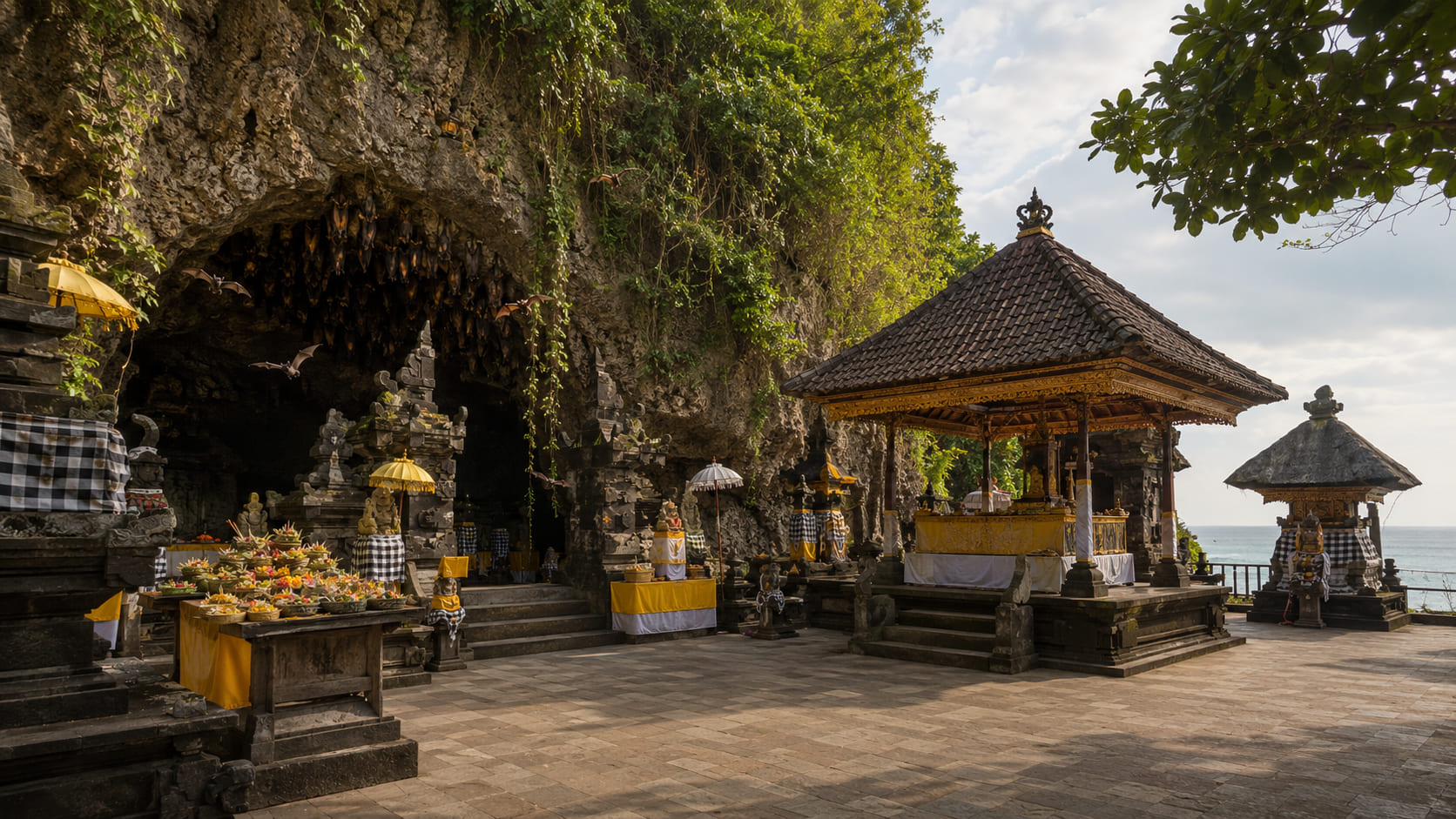
Pura Goa Lawah sits close to Bali’s southeast coast in Klungkung and is built around the mouth of a cave inhabited by large numbers of bats. The cave gives the temple its name: lawah means bat in Balinese. Visitors come because the setting is unusual, but the animals are only one part of the site’s significance.
Goa Lawah is an active temple where worship, offerings and ceremonies can take place beside a heavily traveled coastal road. A respectful visit means treating the cave as part of a sacred environment, not as a wildlife attraction with a temple attached.
The bats are visible, but the cave is not yours to explore
From the temple area, visitors can see bats hanging inside the dark cave entrance and moving in and out. Do not attempt to enter the cave, disturb the animals or use bright flash repeatedly into the colony.
The cave has generated many local legends about its depth and possible underground connections. These stories are culturally interesting, but they should be presented as tradition rather than mapped geological fact unless supported by reliable exploration.
A temple associated with an old religious tradition
Indonesia’s official tourism material describes Goa Lawah as one of Bali’s important temples and connects its traditional foundation with the priest Mpu Kuturan in the eleventh century. You can read the overview on Indonesia Travel.
As with many old sacred sites, visitors should distinguish between traditional history and precisely documented construction dates. The living importance of the temple does not depend on turning every origin story into a modern archaeological claim.
The coast is part of the context
Goa Lawah lies near the sea, and the relationship between mountain and ocean is important in Balinese sacred geography and ritual life. The temple is often encountered by travelers driving between South Bali and the east, which makes it easy to treat as a short roadside stop.
Resist that temptation. The difference between the dark cave, temple courtyards and open coast is part of what makes the place distinctive. Later in this series, a dedicated guide to Bali’s sea temples will explore coastal sacred sites in more detail, but even here you can start noticing how temples are positioned in relation to larger settings.
Late September still brings heat and changing weather
This guide is scheduled for the end of September, when Bali is often transitioning toward wetter months. Days can still be bright and dry, but humidity and afternoon showers may become more noticeable.
Carry water and light rain protection. The temple itself does not require the long physical effort of Gunung Kawi, but wet stone can still become slippery. If heavy rain arrives, wait rather than running through sacred areas or sheltering in a structure that is reserved for ritual use.
How to share space with worshippers
Wear a sarong and sash where required and dress modestly. Keep your voice low near the cave and shrines. The sound and movement of the bat colony can make the site feel dramatic, but visitors should not add to the noise.
During ceremonies, stand well back from processions and offering areas. Do not photograph directly into the face of someone praying. If a temple attendant redirects you, follow the instruction immediately.
The courtyards and gates will be easier to understand if you recognize the layered logic explained in the earlier guide to Balinese temple architecture.
What not to do around the bats
Do not feed wildlife, throw objects toward the cave or try to provoke a mass flight for video. Bats are part of the local ecosystem and should be observed at a distance.
Visitors who are uncomfortable around bats should know that they are a constant presence at the cave mouth. You do not need to approach closely to appreciate the temple. Stay in permitted areas and let the animals remain undisturbed.
Goa Lawah is a good test of respectful curiosity
Unusual sacred places often attract exaggerated stories. Goa Lawah has all the ingredients: a dark cave, thousands of bats, old temple traditions and legends about what lies underground. Curiosity is natural, but a responsible visitor separates what can be observed from what is believed or told.
Observe the cave without entering it. Read the site as a working temple rather than a spectacle. Ask a knowledgeable local guide about stories if you want deeper context, and listen for the difference between oral tradition and historical evidence.
A good visit to Goa Lawah is not measured by how close you get to the bats. It is measured by whether you understand why a community continues to treat the cave and temple as sacred. Give the site time, follow its boundaries and let the unusual setting deepen your attention rather than overwhelm it.