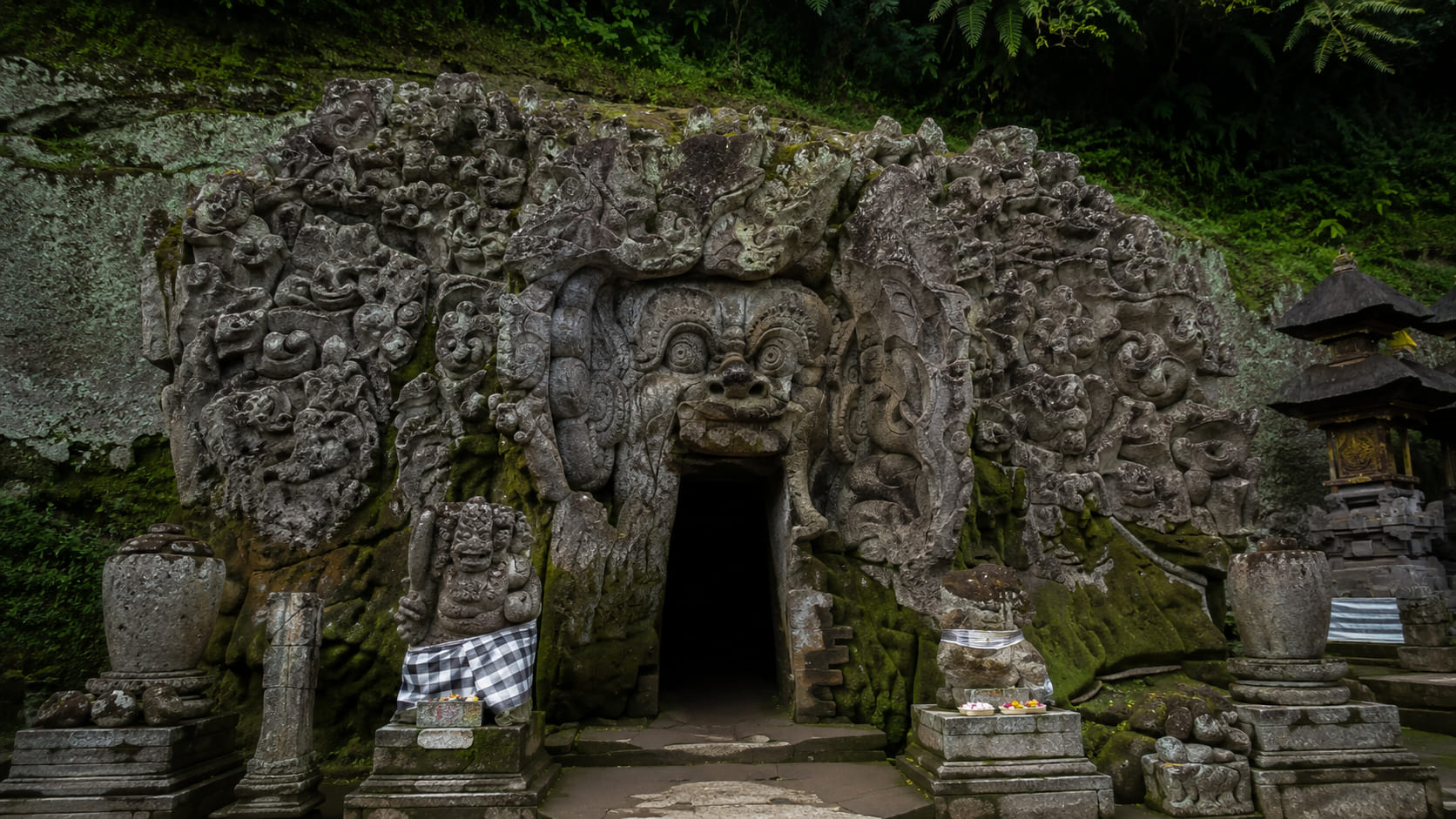
Goa Gajah, commonly called the Elephant Cave, is one of Bali’s most intriguing archaeological and sacred sites. Located near Bedulu in Gianyar, it combines a small rock-cut cave, an elaborate carved entrance, bathing pools, archaeological remains and a green valley setting. The name can create false expectations: you are not visiting a cave filled with elephants, and the most important part of the site is not a wildlife connection.
Goa Gajah rewards visitors who look carefully. Its history contains Hindu and Buddhist elements, and parts of the complex have been revealed through excavation or restored through archaeological work. Because dating and interpretation can vary between sources, it is better to present the site as a layered historical place than force every feature into one simple origin story.
The carved cave entrance is only the beginning
The best-known feature is the dramatic face carved around the cave opening. Visitors often stop here for photographs, enter the short chamber and leave. That misses much of the site.
Inside the cave are niches and sacred objects associated with Hindu practice. The chamber is compact and can become crowded, so move through quietly and do not treat it as a tunnel attraction. People may be praying nearby.
Outside, the site opens into a wider archaeological setting. A bathing pool with stone figures was revealed through twentieth-century archaeological work, and pathways descend toward lower areas with vegetation, water and additional remains. Give yourself enough time to explore beyond the entrance.
How old is Goa Gajah?
Different popular sources give different dates, often placing major elements of the site around the ninth to eleventh centuries. Indonesia’s official tourism site describes Goa Gajah as an archaeological site with ancient carvings and a combination of Hindu and Buddhist elements. You can read its overview on Indonesia Travel.
When dates vary, the responsible approach is to acknowledge uncertainty rather than choose the oldest number because it sounds more impressive. Archaeological places develop over time. A cave, pool, statues and later religious use do not necessarily belong to one construction moment.
Why the name “Elephant Cave” can be misleading
There are several explanations for the name Goa Gajah, and no single tourist-friendly story should be treated as proven. Some interpretations connect the name with Ganesha imagery, while others link it to historical place names. What visitors should not expect is evidence that elephants once lived in the cave.
This is a useful reminder for temple travel generally: names translated into English can produce associations that are stronger than the historical evidence. Let the physical site and credible interpretation guide your understanding.
Look for more than Hindu elements
Goa Gajah is especially interesting because the wider archaeological area contains evidence associated with both Hindu and Buddhist traditions. That makes it a valuable place for thinking about Bali’s long and complex religious history rather than imagining the island’s past as culturally uniform.
Do not try to identify every fragment by yourself from a travel blog. On-site signs, museum interpretation and specialist sources are more reliable for specific iconography. The useful visitor skill is to notice that different remains exist in the same setting and that the site developed across time.
August is a practical time to explore the lower paths
This article is scheduled for late August, normally within Bali’s drier season. Lower rainfall can make the stone paths and valley trails easier to explore than during persistent wet weather, but shaded steps can remain damp and slippery.
Wear shoes with grip and expect stairs. The cave area is compact, yet the wider visit involves more movement than a roadside photo stop. Start earlier in the day for cooler temperatures and fewer groups around the carved entrance.
Respect the site as both archaeology and sacred space
Goa Gajah is not only a preserved ruin. Religious activity continues in parts of the complex. Dress modestly, use a sarong and sash where required, and follow local instructions.
Do not touch carvings, sit on sacred structures or climb archaeological remains. The fact that a stone surface looks strong does not make it an appropriate seat. Physical contact adds wear, especially at sites visited by large numbers of people.
The progression through gates and courtyards will also make more sense if you have read about how Balinese temple space is organized. Goa Gajah is unusual in several ways, but it still sits within a broader culture of sacred thresholds and layered access.
Photography needs restraint inside the cave
The carved entrance is easy to photograph from the public approach, but the interior is small. Avoid blocking the doorway for extended poses or using flash directly around people who are praying. In the bathing pool and lower valley, keep to established paths rather than stepping onto ruins for a better angle.
Wide photographs often tell the story better than close-ups alone. Include the relationship between the cave, pool, stairs and setting. That helps show why Goa Gajah is a complex site rather than one carved facade.
A visit that makes room for uncertainty
Goa Gajah is most interesting when you resist the urge to turn every feature into a neat legend. The exact chronology is complex. The name has competing explanations. Hindu and Buddhist elements share the broader site. Archaeology has changed how parts of the complex are understood.
That uncertainty does not weaken the visit. It makes the place more honest. Walk slowly, read what is available, notice how different historical layers sit together and remember that sacred use can continue even at an archaeological attraction.
If you leave with more questions than you arrived with, that is a good result. Goa Gajah is not a puzzle that a visitor solves in an hour. It is a place where Bali’s archaeology, religion and setting overlap, and it deserves more attention than the famous face at the cave entrance.