Cultural heritage can be damaged by time, weather, natural disasters, conflict, heavy tourism and simple neglect. Technology cannot remove those risks, and a digital copy can never replace a living temple, a museum collection or a community tradition. What technology can do is create records, expand access and help conservators understand what has changed.
For a site focused on Bali’s temples, digital heritage matters because sacred places are both physical and living. Their value exists in stone, brick, wood and setting, but also in ceremonies, craft knowledge, oral history and relationships between communities and place. Preserving only the visible structure would leave much of the heritage undocumented.
What digital preservation actually means
Digitization can begin with something as familiar as high-resolution photography, but serious heritage work goes much further. Museums and cultural institutions create structured digital catalogues, scan documents, record oral histories, map sites and build three-dimensional models. These records can support research, education and conservation when they are created to professional standards.
UNESCO highlights uses ranging from digital mapping to 3D modelling of UNESCO-listed heritage sites. Its work on culture and digital technologies shows how technology is increasingly used to document places and practices that may otherwise be difficult to study or access.
There is an important distinction, however, between making a digital copy and preserving digital heritage for the long term. Files can become unreadable, storage can fail and software formats can disappear. The International Council of Museums has a dedicated Digital Preservation working group because maintaining digital records requires planning, documentation and continued care.
3D scanning and photogrammetry can record physical form
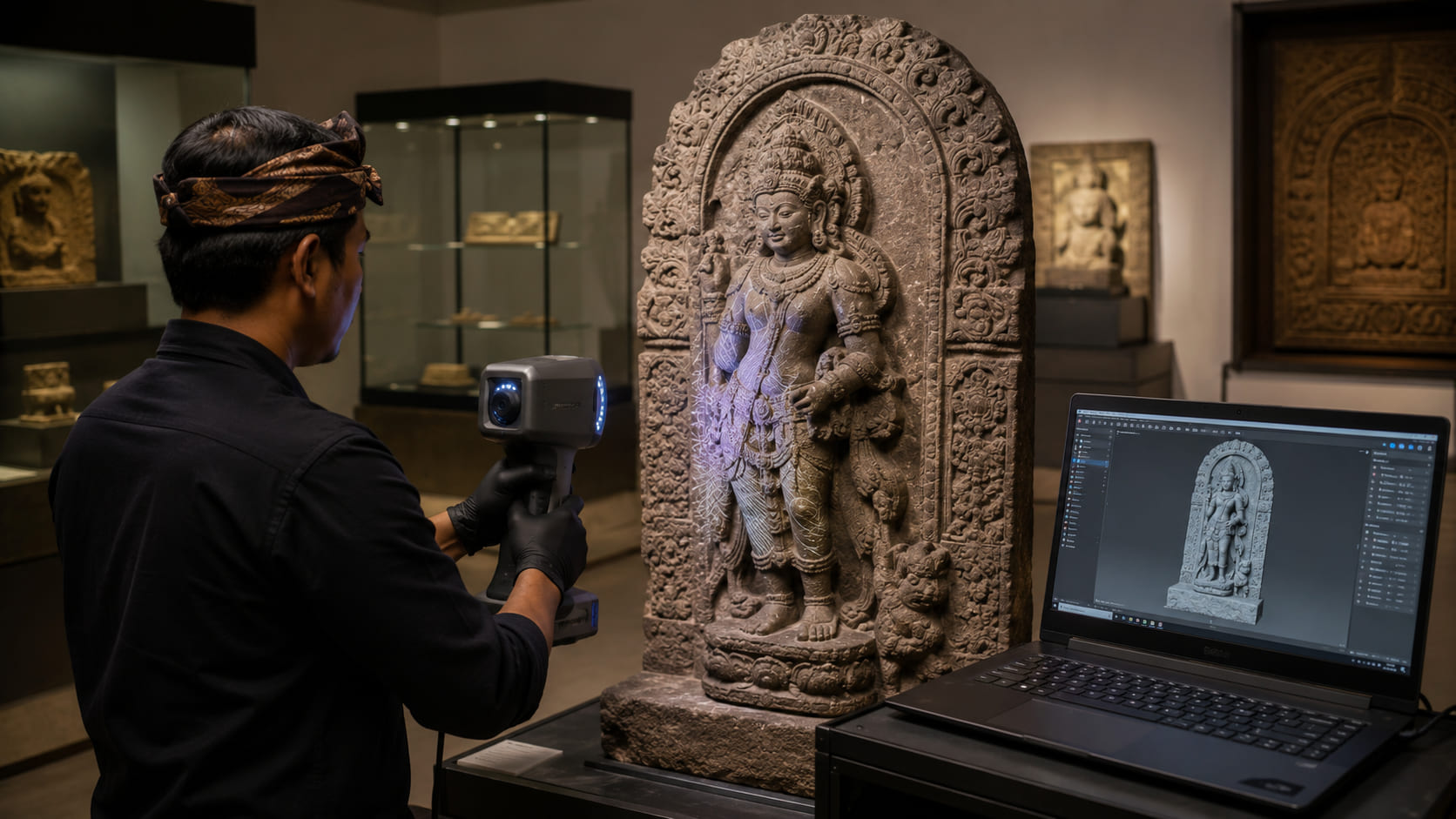
One of the most useful tools for built heritage is three-dimensional documentation. Laser scanning can capture millions of measurements across a structure, while photogrammetry can create a 3D model by combining many overlapping photographs. These methods allow specialists to record proportions, surfaces and spatial relationships with far more detail than a few conventional photographs.
For temple architecture, a good 3D record can help document gateways, carvings, roof forms and courtyard relationships. It can also provide a baseline for future comparison. If a wall shifts, a carving erodes or a structure is damaged, later surveys can be compared with earlier data.
This does not mean every sacred site should be scanned and placed online in full. Some spaces, objects or rituals may be restricted. The cultural authority to decide what is recorded and shared should not be replaced by the enthusiasm of a technology company or visitor.
Museums turn objects into connected information
A museum object is more useful to researchers when its digital record contains more than a photograph. Good documentation can include the object’s material, dimensions, condition, origin, maker, date, acquisition history and relationship to other objects. Standardized metadata helps collections remain searchable and understandable across time.
Digital catalogues can also reconnect information that physical displays separate. A carved architectural fragment in a museum may be linked digitally to old photographs of the site where it once stood, conservation reports and oral histories from the surrounding community. The result is a richer record than any single display label can provide.
For readers learning about temple form, this kind of documentation complements a practical introduction to Balinese temple architecture. One explains how a living compound functions; the other helps show how specialists can record that material culture responsibly.
Virtual access has value, but it has limits
Virtual tours, augmented reality and immersive museum experiences can make heritage accessible to people who cannot travel. They can also help visitors prepare before arriving at a fragile or sacred site. A digital reconstruction may show how a damaged structure once looked, while an interactive model can explain layers that are hard to see on site.
The risk is that reconstruction can look more certain than the evidence really is. A polished 3D model may include assumptions about colors, missing roofs or historical layouts. Responsible projects should distinguish measured data from interpretation and explain where uncertainty remains.
Virtual access also does not grant cultural access. A sacred inner courtyard that is closed to visitors should not automatically become unrestricted digital content. The same ethical questions that apply to photography in a temple can apply to scanning and virtual reality.
Technology works best when communities remain in control
Heritage preservation can become extractive when outsiders collect images, scans and stories without meaningful participation from the people whose culture is being documented. The most responsible projects involve local institutions, religious authorities, craftspeople and communities from the beginning.
Community knowledge can correct technical mistakes. A scanner may record the shape of a shrine perfectly while missing why it matters, who may approach it or when it is used. Digital preservation is strongest when technical accuracy and cultural context are treated as equally important.
Rights also matter. Institutions need clear policies about who owns data, who may reuse images, what should remain restricted and how sensitive information is protected. Open access can be valuable, but openness should not be treated as an automatic moral good when sacred or community-controlled knowledge is involved.
The real goal is continuity, not a digital replica
The best digital heritage projects do not claim to replace physical conservation or living tradition. They support them. A 3D model can help document a temple, but it cannot maintain the roof. A video can record a ceremony, but it cannot preserve the community relationships that give the ceremony meaning. A museum database can protect information, but it still needs people to update and interpret it.
Technology is most useful when it creates a careful record, widens responsible access and helps future generations understand what existed and why it mattered. For Bali’s temples and cultural practices, that means preserving context as well as form. The strongest digital archive is not the one with the most files. It is the one that remains accurate, usable and respectful of the people connected to the heritage it records.